The rise of renewable energy sources, especially the construction of wind farms, is vital for energy security and the future of our planet. But how does the new infrastructure affect the life of one of the most important ecosystem service providers, bees?
Before examining the impact of wind turbines, it is worth recalling why protecting bees is so crucial.
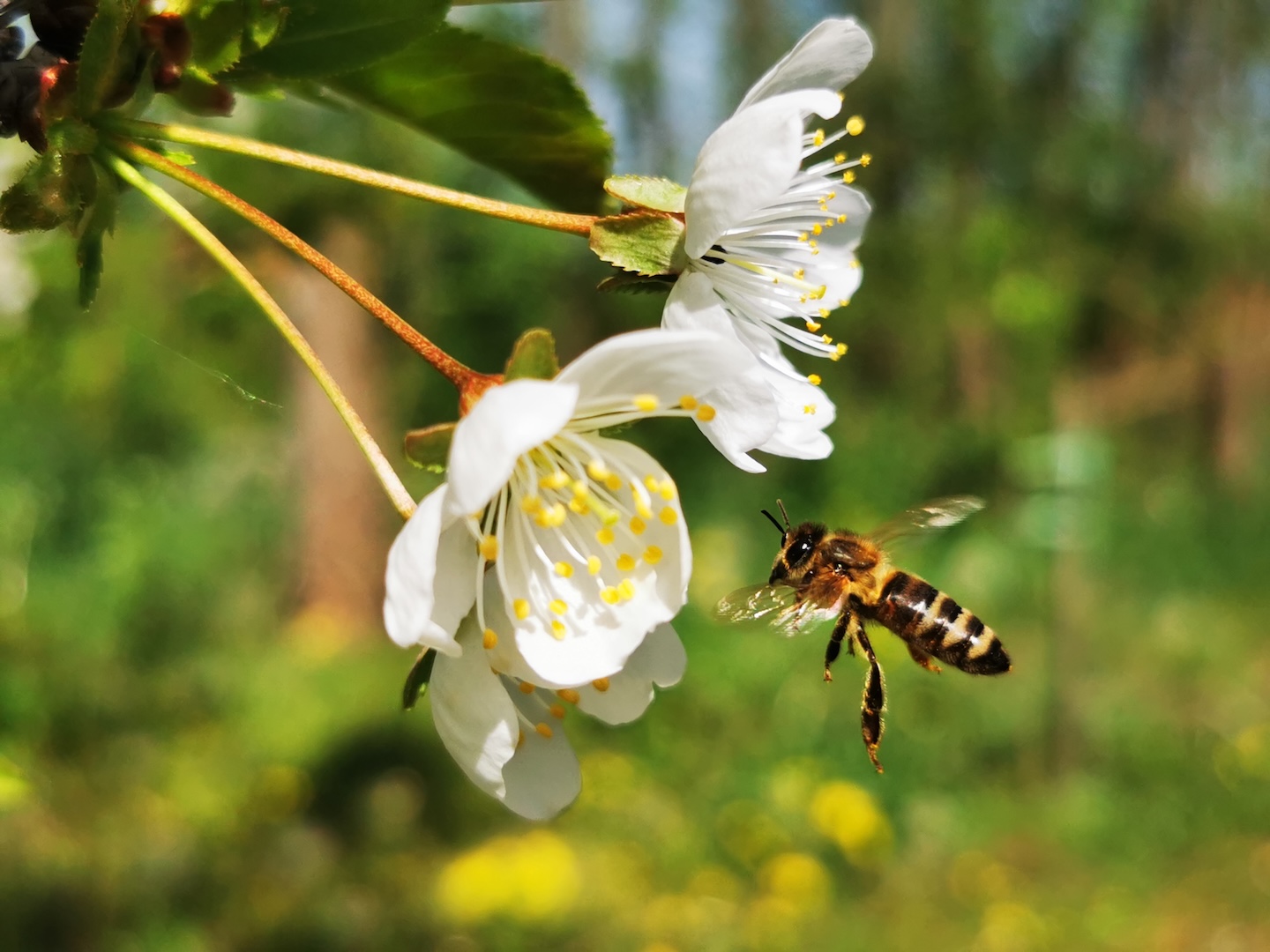
Bees play an outstanding role in both natural ecosystems and agriculture due to their pollination activities. This process is essential for the reproduction of many plant species and for crop yields. If bees are absent, plant pollination declines, directly threatening food security.
Below are some startling figures on the value of pollination:
- Around 75% of the world’s crop species require animal pollination to some extent.
- The annual value of global pollination provided by bees is estimated at EUR 153 billion.
- 85-90% of wild plant species depend on animal pollination, so the absence of bees may also lead to changes in the composition of natural vegetation and even the collapse of the food chain.
It is also important to mention that bees are not only pollinators, but also produce valuable products (e.g. honey, wax, propolis) that can be used as food, in medicine and for industrial purposes.
Many people wonder whether the blades of wind turbines pose a deadly threat to flying insects.
The clear answer to this is no.
According to the literature, the reason for this lies in the flight altitude of bees:
- When searching for flowers, honey bees (Apis mellifera) usually fly at a height of 1-10 metres, but during navigation they can rise as high as 20-40 metres.
- Bumblebees (Bombus sp.) are mainly active at heights of 0.5-2 metres, and when avoiding obstacles they rise to no more than 5-8 metres.
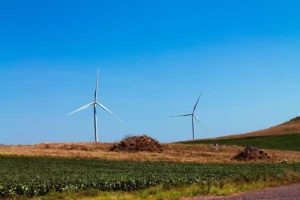
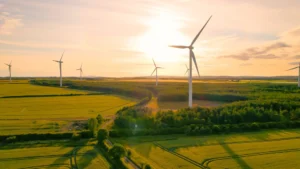
Since the rotor blades of wind turbines typically operate at heights of 40–190 metres, this zone is well above the typical flight range of bees, so the direct collision risk is very low. A study in France also confirmed this: turbine operation did not negatively affect the mortality of forager bees, the mating flights of queens or the development of colonies. Another important consideration is that bees, which are active during the day, are also unaffected by the night-time lights of wind turbines.
Although the blades do not pose a direct threat, meaning that wind turbines on their own cause bee deaths only in exceptional cases, insufficiently careful planning and poor site selection can result in significant local ecological damage.
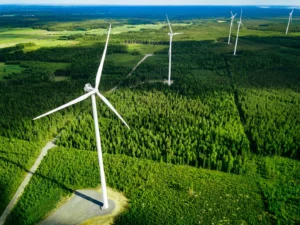
The root of the problem is the infrastructure development involved in installing wind farms. The construction of roads, the cable network and foundations involves earthworks and the removal of vegetation, which reduces the number of plants in the area and, therefore, fewer nectar and pollen sources are available to bees. The construction of roads and foundations can cause the loss or fragmentation of areas, particularly in semi-natural habitats rich in wildflowers (grasslands, shrublands, marshes).
The good news is that the potential adverse effects can largely be mitigated and the local ecological condition can even be improved. The key to protection is conscious planning and aftercare.
The most important elements of this are as follows:
- Careful site selection: wind turbines should not be installed near protected areas (e.g. Natura 2000), grasslands with high biodiversity, semi-natural habitats or main pollinator migration routes.
- Habitat restoration: the natural vegetation cover must be restored in areas damaged during construction. It is advisable to sow wildflower seed mixtures of local origin, create bee pasture in the affected areas and restore patches of shrubland.
- Maintaining green corridors: It is advisable to maintain green corridors along maintenance roads (e.g. flowering strips without mowing during the flight period).
At Green Energy Investhor, we are fully committed to complying with these recommendations. Accordingly, from the start of the planning phase of our Vadosfa wind farm project, we held several rounds of consultations with the national parks and government offices concerned regarding the installation sites. We have undertaken to restore the damaged areas to their original condition once the construction works have been completed and to monitor the fauna and flora of the affected areas for at least one year.
We used the following sources to prepare our article:
Capaldi, E. A., Smith, A. D., et al. (2000). Ontogeny of orientation flight in the honeybee revealed by harmonic radar. Nature.
Fourrier, J., Fontaine, O., Peter, M., Vallon, J., Allier, F., Basso, B., & Decourtye, A. (2023). Is it safe for honeybee colonies to locate apiaries near wind turbines? Entomologia Generalis, 43(4).
Gallai, N., Salles, J. M., Settele, J., Vaissiere, B. E. (2009). Economic valuation of the vulnerability of world agriculture confronted with pollinator decline. Ecological Economics, 68(3), 810–821. https://doi.org/10.1016/j.ecolecon.2008.06.014
IPBES (2016). The Assessment Report on Pollinators, Pollination and Food Production. https://ipbes.net/assessment-reports/pollinators
Klein, A. M., et al. (2007). Importance of pollinators in changing landscapes for world crops.
Proceedings of the Royal Society B: Biological Sciences, 274(1608), 303–313.
https://doi.org/10.1098/rspb.2006.3721
Osborne, J. L., et al. (1999). A landscape-scale study of bumblebee foraging range and constancy using harmonic radar. Journal of Applied Ecology.
Toth, A. L., Kőszegi, T., et al. (2019). Foraging behaviors of honeybees and bumble bees in agricultural landscapes. Journal of Apicultural Research.
Waddington, K. D., et al. (1994). Flight patterns of foraging honeybees: range and altitude explored using harmonic radar. Journal of Experimental Biology.