Over the past decade and a half, no new wind farm developments have been able to take place in Hungary, but thanks to the regulatory changes introduced in 2023, the country can once again open the way for wind energy. The aim is to triple domestic capacity by 2030 – while the technology is now far safer, more efficient and more environmentally friendly than before.
Below, we have collected the most important things to know about wind turbines and explain how they actually work.
Wind turbines enable efficient land use
Modern turbines have an exceptionally low land requirement, just 3-5 percent of the land required by a solar farm of the same capacity.
Agricultural cultivation can continue on the areas around the towers, thus renewable energy production does not take away arable land.
Wind turbines can be integrated stably into the power grid
The electricity generated by windfarms is fed directly into the MAVIR grid.
This ensures that generation does not cause voltage fluctuations or an intermittent supply on local low-voltage networks.
With appropriate planning, the impact of turbines on flora and fauna can be minimised
Wind turbine tower sites are selected on the basis of professional consultations with the national parks concerned, as well as detailed environmental impact studies, which also include at least one year of bird, bat, and plant monitoring.
It is important to emphasise that the blades of modern turbines rotate more slowly, and several types are equipped with cameras which, communicating with systems powered by artificial intelligence, can monitor birds – slowing down or stopping the rotors if necessary. Research shows that road traffic and domestic cats play a role in bird mortality that is several thousand times greater than that of wind farms.
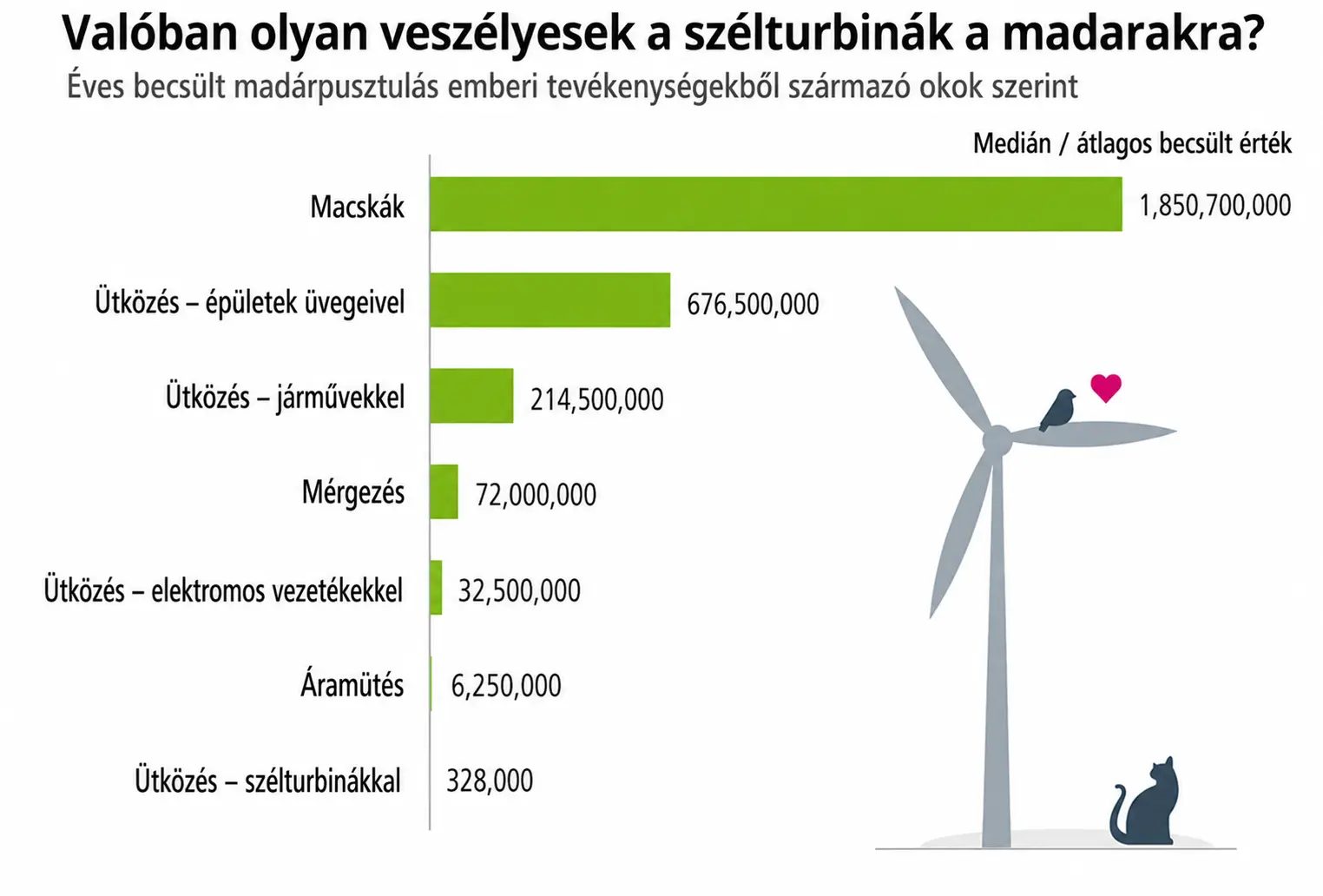
Source: U.S. Fish and Wildlife Service
Wind turbines do not significantly disturb hunting or game populations
The installation and operation of wind turbines does not significantly disturb game populations, nor does it hinder hunting. Before developments take place, a mandatory environmental impact assessment is prepared, covering wildlife, bird migration and noise impacts. Experience shows that local animal populations quickly get used to the operation of the turbines and continue to use the surrounding areas. In most cases, hunting activities can continue undisturbed, taking safety zones into account.
Wind turbines have no effect on bees
Wind turbines do not emit ultrasound or any other frequency that would affect bees or other pollinators. As their operation does not involve the emission of chemicals and does not affect the temperature of the air or vegetation, and as bees generally fly at heights of 10-40 metres, wind turbines have no effect on bee populations. On the contrary: the use of renewable energy helps reduce climate change and vegetation stress in the long term, which is beneficial for pollinator species.
You can read more about the effects on bees HERE
Modern turbines are surprisingly quiet in operation, so they do not disturb people living nearby
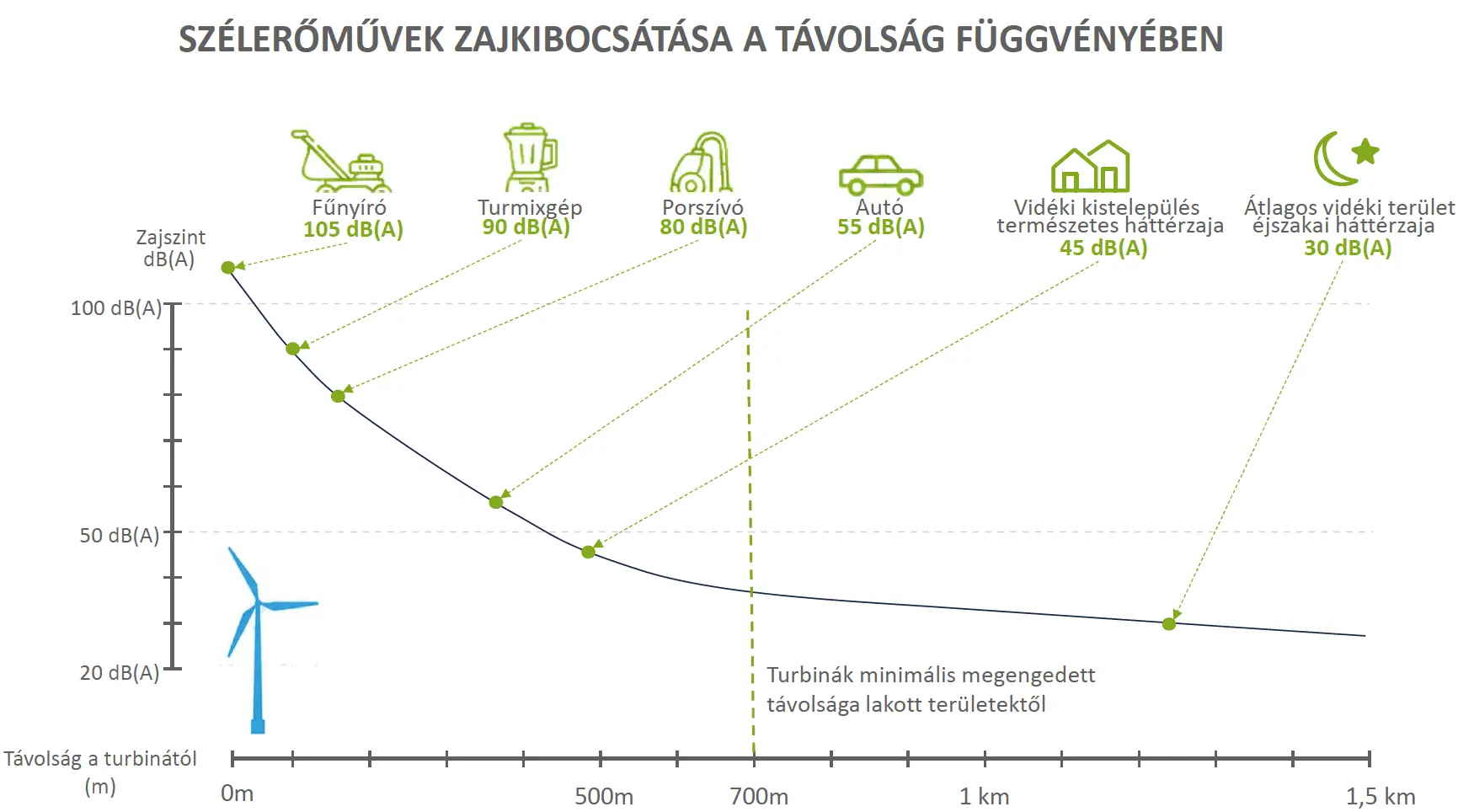
Modern turbine technology has made enormous progress over the past decade: today, they operate on 130-metre towers, reaching an overall height of up to 220 metres, with 90-metre rotor blades. Their larger size means a lower rotational speed, so rotors are now much quieter than earlier models. The noise emission calculations for the wind turbines we intend to build show that the noise emitted will be below the limit value beyond 350-400 metres from the wind turbines, and will not be audible even at night in residential properties located beyond the 700-metre boundary from residential areas.
Wind turbines do not cause health problems
Studies by international and domestic health organisations have not found any links between the operation of wind turbines and any harm to health.
Wind turbine installation causes noise and dust pollution only for a short period of time
The construction phase may indeed involve temporary dust and noise, but these effects are short-lived and occur only during earthworks, foundation work and transport. After construction, all environmental impacts cease and the area is fully restored.
Wind turbines are self-sufficient systems
The turbines generate the electricity they need for their own operation themselves, and this amount is negligible – just 2 percent of the energy generated.
The towers are not at risk from stronger storms
Modern wind turbines have built-in safety systems. If wind speed exceeds safe levels, the turbine shuts down automatically, so it is not damaged and does not pose a danger to people living nearby.
Rotor icing has now been resolved
Compared to older wind turbine types, the lower rotor speed of the latest models also reduces the likelihood that, in the event of icing, pieces of ice breaking off will fly a long distance and cause injury or property damage. In addition, rotor blades can now also be ordered with heating elements, which can prevent icing.
Wind turbines can be operated for a long time and are recyclable to a significant extent
Manufacturers guarantee a service life of 25–30 years for wind turbines, but most components can be replaced several times. Wind turbines are 85–90 percent recyclable: steel, aluminium, copper and concrete components can be reused or remelted. The material from the blades is used in cement production, the plastics industry and as an additive in the construction industry, and in more and more places they are even given a new function – for example as noise barriers, bicycle storage facilities or playground elements.
Modern wind turbines blend into the landscape
The impact of turbines on the view is significantly reduced by painting the towers in shades of green that gradually fade in several stages, helping them blend into the landscape. At the same time, several surveys show that in locations where wind turbines have already been installed, many people actively like the sight of the towers and, in fact, in many places they are considered tourist attractions.
The towers are also safe from an aviation perspective
Wind turbines do not interfere with aviation; the safety of aircraft is ensured by red night-time warning lights placed on top of the wind towers. Where several turbines are installed close to one another, modern systems also have passive radar sensors, so the lights only flash when an aircraft is approaching, avoiding unnecessary light pollution.